Oregon — ODA

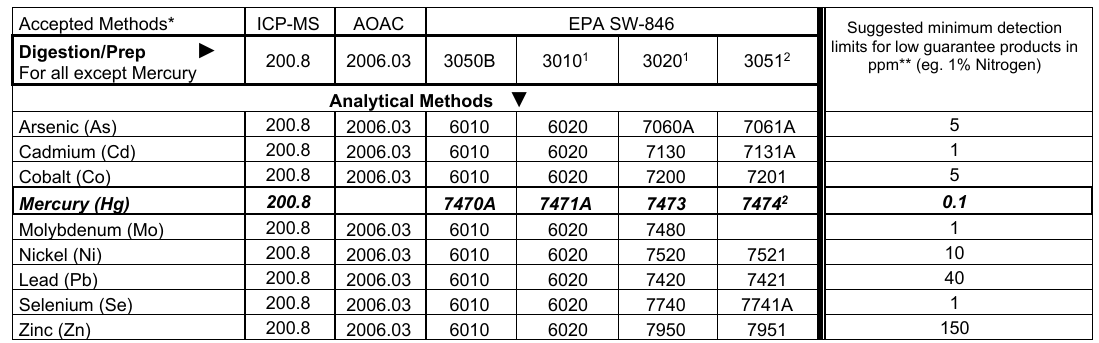
Oregon Department of Agriculture (ODA) requires heavy-metal disclosures for registered fertilizer products.

Metals that must be submitted:
arsenic (As), cadmium (Cd), mercury (Hg), lead (Pb), nickel (Ni)

Guideline applied:
The initial application for registration of a fertilizer, agricultural amendment, agricultural mineral or lime product must include a statement of the levels of metals in the product, including but not limited to arsenic (As), cadmium (Cd), mercury (Hg), lead (Pb), nickel (Ni) or other metals or substances identified by the department by rule. The registrant must provide a laboratory analysis report, in accordance with acceptable methods required by the department, to verify the levels of metals or other substances in the product. Subsequent to initial product registration, the registrant shall provide a laboratory analysis report for the product to the department upon request. An initial or subsequent laboratory analysis must have been conducted no more than 18 months prior to submission of that analysis to the department.

The department shall establish by rule the level of metals or other substances permitted in fertilizer, agricultural amendment, agricultural mineral and lime products registered with the department, including but not limited to the permitted levels of arsenic (As), cadmium (Cd), mercury (Hg), lead (Pb), nickel (Ni) or other metals or substances identified by the department by rule for the purpose of protecting humans, animals, water, aquatic life, soil or beneficial plant life. The department shall review the permitted level of metals or other substances in fertilizer, agricultural amendment, agricultural mineral and lime products a minimum of once every five years.

Limits of Non Nutritive Constituents

a) When the product has a guaranteed analysis of available phosphate (P2O5), for each percent of P2O5 guaranteed, the maximum allowed level of a metal, expressed in parts per million (ppm), must not exceed: 9 ppm arsenic, 7.5 ppm cadmium, 43 ppm lead, 0.7 ppm mercury, 175 ppm nickel.

(A) To determine the maximum allowed concentration of each metal in a product, multiply the percent guaranteed P2O5 for the product by the maximum allowed level of the metal.

(B) For the purpose of calculating the maximum allowed concentration of a metal in a product with a guaranteed analysis of less than six percent P2O5, the minimum percent of P2O5 utilized as a multiplier shall be 6.0.

(b) When the product has no guaranteed analysis of available phosphate (P2O5) but does have a guaranteed analysis of one micronutrient, for each percent of the micronutrient guaranteed, the maximum allowed level of a metal, expressed in parts per million (ppm), must not exceed: 76 ppm arsenic, 61 ppm cadmium, 340 ppm lead, 4.5 ppm mercury, 1330 ppm nickel.

(A) To determine the maximum allowed concentration of each metal in a product, multiply the percent of the micronutrient guaranteed for the product by the maximum allowed level of the metal.

(B) For the purpose of calculating the maximum allowed concentration of a metal in a product with less than one percent micronutrient guaranteed, the minimum percent of micronutrient utilized as a multiplier shall be 1.0.

(c) When the product has no guaranteed analysis of available phosphate (P2O5) but does have a guaranteed analysis of two or more micronutrients, for each percent of the micronutrient in the greatest concentration, the product shall not contain more than 76 parts per million (ppm) arsenic, 61 ppm cadmium, 340 ppm lead, 4.5 ppm mercury, 1330 ppm nickel.

(A) To determine the maximum allowed concentration of each metal in a product, multiply the percent of the micronutrient guaranteed for the product in the greatest concentration by the maximum allowed level of each metal.

(B) For the purpose of calculating the maximum allowed concentration of a metal in a product with less than one percent micronutrient guaranteed, the minimum percent of micronutrient utilized as a multiplier shall be 1.0.

(d) When the product has a guaranteed analysis of available phosphate (P2O5) and has a guaranteed analysis of one micronutrient, the product shall not contain more of any metal than the higher of the two resulting values as calculated in (a) or (b) above, specifically: To determine the maximum allowed concentration of a metal in a product, multiply the percent guaranteed P2O5 for the product by the maximum allowed level of the metal as stated in (a) above. Then multiply the percent of the micronutrient guaranteed for the product by the maximum allowed level of the metal as stated in (b) above. Utilize the higher of the two resulting values as the maximum allowable metal concentration.

(e) When the product has a guaranteed analysis of available phosphate (P2O5) and has a guaranteed analysis of two or more micronutrients, the product shall not contain more of any metal than the higher of the resulting values as calculated in (a) or (c) above. To determine the maximum allowed concentration of each metal in a product, multiply the percent guaranteed P2O5 for the product by the maximum allowed level of the metal as stated in (a) above. Then multiply the highest percent of a micronutrient guaranteed for the product by the maximum allowed level of the metal as stated in (c) above. Utilize the higher of the resulting values as the maximum allowable metal concentration.

(f) When the product has no guaranteed analysis of available phosphate (P2O5) and no guaranteed analysis of a micronutrient, the product shall not contain more than: 54 parts per million (ppm) arsenic, 45 ppm cadmium, 258 ppm lead, 4.2 ppm mercury, 1050 ppm nickel.

(2) Any fertilizer, agricultural amendment, agricultural mineral or lime product which is made from zinc recycled hazardous wastes as regulated under the Resource Conservation and Recovery Act (RCRA) must comply with the existing, applicable land disposal restriction (LDR) treatment standards for the hazardous wastes the products contain or comply with the conditions for excluding hazardous secondary materials as established in the Federal Register/Vol.67, No. 142/Wednesday, July 24, 2002/Pages 48393–48415.

(3) The department will review the permitted levels of metals or other substances in fertilizer, agricultural amendment, agricultural mineral and lime products every three years as authorized by ORS 633.362(11).

Reference:
oregonlegislature.gov/bills_laws/ors/ors633.html
Oregon Secretary of State Administrative Rules